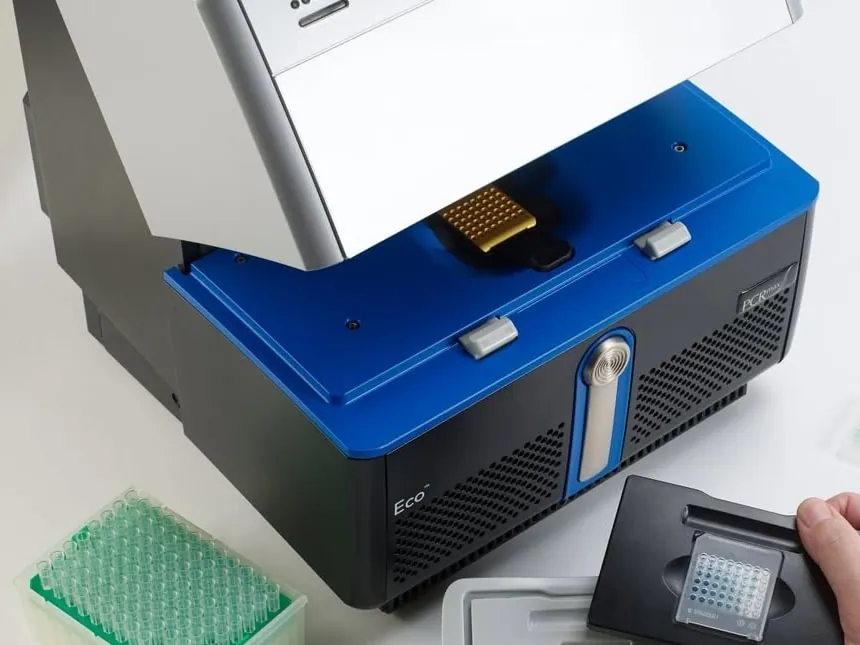
PCRmax Eco 48
Real-time PCR (qPCR) system
Compact 48-well real-time PCR system with reactions from 5 μl, up to four dyes per run, HRM as standard and 40 cycles in about 40 minutes.
- Brand
- PCRmax
- Model
- Eco 48
- Category
- Molecular biology
Supplied and supported in Egypt
GLHS provides consultation, installation, user training and after-sales support for the products it supplies.
Overview
The PCRmax Eco 48 is a compact real-time PCR (qPCR) instrument for research, teaching and food-analysis laboratories that run gene-expression, genotyping and detection assays. Its small plate format suits labs with moderate sample numbers that want to save reagents, and it occupies a bench footprint of about 34.5 × 31 cm.
The system uses a 48-well polypropylene plate with the same well geometry as a 384-well plate, so validated reaction volumes start at 5 μl and reagent use is reduced. It supports up to four dyes for multiplex assays and includes high-resolution melt (HRM) analysis as standard. A standard run of 40 cycles takes about 40 minutes. It is an open platform for any qPCR chemistry, and the software handles instrument control, data collection and analysis.
GLHS has supplied and installed Eco 48 systems at Egyptian university research and food-analysis laboratories and trained their users.
Key features
- 48-well plate with 384-well geometry
- Validated minimum reaction volume of 5 μl
- Multiplexing with up to four dyes
- High-resolution melt (HRM) analysis as standard
- 40 cycles in about 40 minutes with standard protocols
- Open platform for any qPCR chemistry; MIQE-compliant software
Technical specifications
| Plate format | 48-well polypropylene plate |
|---|---|
| Minimum reaction volume | 5 μl |
| Detection | Up to 4 dyes per run |
| Run time | 40 cycles in about 40 min (standard protocol) |
| Footprint | 34.5 × 31 cm |
Specifications are those published by the manufacturer and may change without notice. Please confirm the current configuration with our team.
Applications
- Gene expression and quantitative PCR assays
- Genotyping and SNP discrimination by HRM
- Molecular detection in food-analysis laboratories
- University research and teaching laboratories